Dock Plates vs. Dock Levelers: What’s the Difference?
In busy warehouses and commercial facilities, efficiency matters. Every truck that pulls into a loading dock represents products that need to move quickly, safely, and smoothly. But without the right loading dock equipment, even simple loading and unloading tasks can become slow, unsafe, and frustrating.
That’s where dock plates and dock levelers come in.
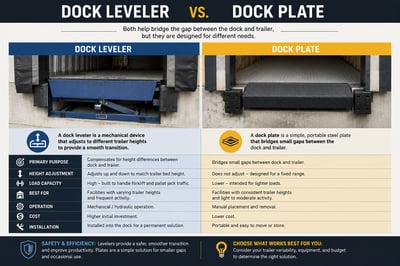

Although they serve a similar purpose, bridging the gap between a loading dock and a trailer, they are designed for very different applications. Choosing the right option can improve safety, reduce downtime, protect equipment, and make day-to-day operations much more efficient.
At Overhead Door Company of Central Jersey, we’ve spent more than 50 years helping businesses throughout New Jersey improve their loading dock operations with dependable commercial overhead door and loading dock equipment solutions. One of the most common questions we hear from facility owners and warehouse managers is whether they should install dock plates or dock levelers. The answer depends on the type of work your facility handles every day.
Understanding Dock Plates
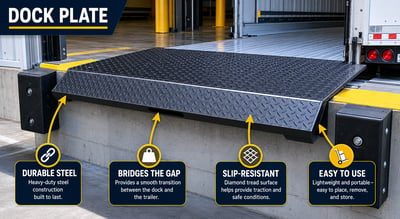
Dock plates are one of the simplest loading dock solutions available. They are portable plates, usually made from aluminum or steel, that temporarily bridge the gap between a trailer and the dock floor.
Their primary purpose is to create a smooth path for moving products between the truck and the facility.
These dock bridging plates are especially popular in smaller warehouses, retail facilities, and businesses that don’t deal with constant heavy forklift traffic. Because they are lightweight compared to loading dock levelers, they can often be repositioned manually and stored away when not in use.
For businesses looking for a practical and affordable loading dock solution, dock plates can be extremely useful.
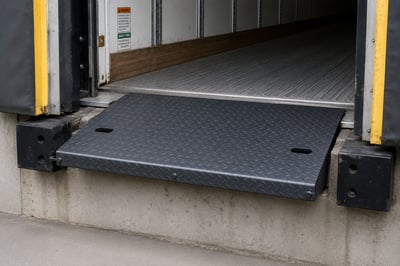 Portable steel dock plate bridges the gap between a loading dock and trailer
Why Businesses Use Dock Plates
One of their biggest advantages is convenience. They’re easy to use, easy to move, and easy to store. If your operation only handles occasional deliveries or lighter loads, a dock plate may provide everything you need without requiring a large investment.
These portable plates are also excellent for bridging smaller gaps between trailers and loading docks. Without a stable transition point, carts and pallet jacks can struggle to move safely across uneven spaces. They solve this issue quickly and efficiently.
Many modern loading dock plates also include safety features like locking legs or curbs that help stabilize the plate during use and reduce shifting.
Another advantage is flexibility. Since they are portable, they can be used in multiple dock positions throughout a facility. For businesses with changing workflows or limited dock space, this portability can be very helpful.
However, they do have limitations.
The Limitations of Dock Plates
While they work well for lighter applications, they are generally not designed for constant heavy-duty use. Repeated forklift traffic and oversized loads can place excessive stress on the plate, reducing its lifespan and potentially creating safety concerns.
This becomes especially important in busy industrial environments where loading docks operate continuously throughout the day.
Another issue is efficiency. Since these plates often need to be manually positioned and removed, they can slow down operations in facilities with frequent truck traffic. Over time, these extra steps can reduce productivity and increase labor demands.
Safety can also become a concern if the plate is not positioned properly. An unstable transition between the trailer and dock may increase the risk of accidents, damaged products, or equipment strain.
For facilities with heavier demands, dock levelers are often the better long-term solution.
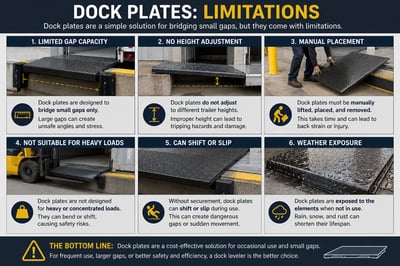 Common limitations of dock plates

What Is a Dock Leveler?
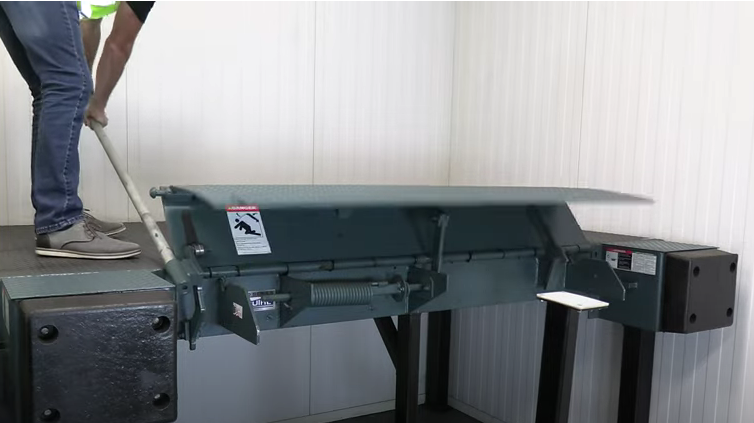
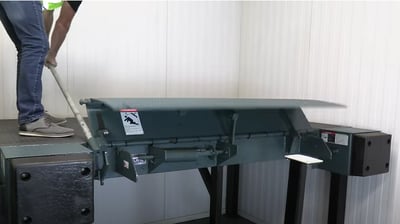
Loading dock levelers are permanent loading dock systems designed to create a stable bridge between the dock floor and trailers of varying heights.
Unlike dock plates, they are fixed directly into the loading dock structure and remain in place at all times. They are specifically engineered to support forklifts, heavy machinery, pallets, and constant loading activity.
These dock bridge systems can be mechanical, hydraulic, or air-powered depending on the facility’s operational needs.
Their main purpose is to improve safety, efficiency, and productivity during loading and unloading operations.
One of the biggest benefits of this heavy-duty loading dock equipment is durability. They are designed to withstand the daily demands of warehouses, distribution centers, manufacturing facilities, and industrial buildings where heavy equipment moves continuously.
Forklifts carrying thousands of pounds place enormous pressure on loading dock systems. Dock levelers are built to handle that stress safely and consistently.
Another major advantage is speed. Because they remain permanently installed, employees can move quickly between trailers and the facility without constantly repositioning equipment. This helps improve workflow and reduce downtime.
In high-volume shipping environments, even small time savings can make a major difference over the course of a day.
These dock lift systems also help reduce “dock shock,” which occurs when forklifts bounce or shift while moving between uneven trailer and dock surfaces. This rough transition can damage equipment, create operator discomfort, and increase wear on forklifts.
By creating a smoother transition point, these industrial dock levelers improve both safety and operational efficiency.
Loading docks are one of the busiest and most accident-prone areas in commercial facilities. Uneven surfaces, unstable equipment, and poorly secured transitions can create serious hazards for employees and equipment operators.
That’s why choosing the right loading dock equipment is about much more than convenience.
Dock levelers are specifically engineered with safety in mind. Many models include built-in safety legs, hydraulic controls, emergency stops, and other protective features designed to reduce the risk of accidents.
Because they are permanently installed, they also provide greater stability than portable dock plates in demanding environments.
For facilities that rely heavily on forklifts and constant shipping activity, that additional safety can make a significant difference.
Which Option Is Best for Your Facility?
The best choice depends entirely on how your facility operates.
If your business handles lighter shipments, occasional deliveries, or limited loading dock traffic, portable loading dock plates may provide a simple and cost-effective solution. They are flexible, mobile, and practical for many smaller commercial applications.
However, if your operation depends on forklifts, high shipping volumes, and continuous loading activity, dock levelers are usually the smarter investment. Their durability, efficiency, and safety features make them ideal for demanding industrial environments.
It’s also important to think long term.
Many growing businesses initially install dock plates because they are less expensive upfront. But as operations expand and shipping demands increase, those same businesses often find themselves needing a more permanent and heavy-duty solution.
Planning ahead can help avoid unnecessary costs and operational disruptions later.
At Overhead Door Company of Central Jersey, we understand how important reliable loading dock systems are to daily business operations. A slow or unsafe dock area can affect productivity, employee safety, shipping schedules, and customer satisfaction.
That’s why we help businesses throughout New Jersey choose loading dock equipment that matches their operational needs.
Whether you need dock plates, dock levelers, commercial overhead doors, security grilles, or industrial door systems, our experienced team can help you find the right solution for your facility.
After more than five decades serving Central Jersey businesses, we’ve seen firsthand how the right equipment can improve workflow, reduce downtime, and create a safer working environment.
If you’re considering upgrading your loading dock equipment or want help deciding between dock plates and dock levelers, we’re here to help.
Our team can evaluate your facility, discuss your operational goals, and recommend the best solution for your workflow and budget.
Phone: 908-386-5267
Email: comm@overheaddoorco.com
When it comes to loading dock safety, efficiency, and long-term performance, choosing the right equipment makes all the difference.